A000040
The prime numbers.
DATA
2, 3, 5, 7, 11, 13, 17, 19, 23, 29, 31, 37, 41, 43, 47, 53, 59, 61, 67, 71, 73, 79, 83, 89, 97, 101, 103, 107, 109, 113, 127, 131, 137, 139, 149, 151, 157, 163, 167, 173, 179, 181, 191, 193, 197, 199, 211, 223, 227, 229, 233, 239, 241, 251, 257, 263, 269, 271PYTHON IMPLEMENTATION
Executable sequence implementation based on goulib.sequence.Sequence:
Main definition:
A000040 = Sequence(math2.primes_gen, None, math2.is_prime, 'The prime numbers')
⚙ Console d'évaluation en direct
Testez les fonctions itemf(n) et containf(x) directement dans cette page :
Prêt. Cliquez sur un bouton ci-dessus.
Detail of provided methods:
| Function | Expression | Description |
|---|---|---|
iterf |
math2.primes_gen |
Generator iterating over the infinite sequence |
itemf(n) |
None |
Direct computation of $n$-th term |
containf(x) |
math2.is_prime |
Boolean membership test ($x \in S$) |
PROGRAMS
Maple
A000040 := n->ithprime(n); [ seq(ithprime(i),i=1..100) ];
# For illustration purposes only:
isPrime := s -> is(1 = sin(Pi*GAMMA(s)/s)/sin(Pi/s)):
select(isPrime, [$2..100]); # _Peter Luschny_, Feb 23 2018
Mathematica
Prime[Range[60]]
Other Programs
- (Magma) :
[n : n in [2..500] | IsPrime(n)];
- (Magma) :
a := func< n | NthPrime(n) >;
- (PARI) :
{a(n) = if( n<1, 0, prime(n))};
- (PARI) :
/* The following functions provide asymptotic approximations, one based on the asymptotic formula cited above (slight overestimate for n > 10^8), the other one based on pi(x) ~ li(x) = Ei(log(x)) (slight underestimate): */
prime1(n)=n*(log(n)+log(log(n))-1+(log(log(n))-2)/log(n)-((log(log(n))-6)*log(log(n))+11)/log(n)^2/2)
prime2(n)=solve(X=n*log(n)/2,2*n*log(n),real(eint1(-log(X)))+n)
\\ _M. F. Hasler_, Oct 21 2013
- (PARI) :
forprime(p=2, 10^3, print1(p, ", ")) \\ _Felix Fröhlich_, Jun 30 2014
- (PARI) :
primes(10^5) \\ _Altug Alkan_, Mar 26 2018
- (SageMath) :
a = sloane.A000040
a.list(58)  # _Jaap Spies_, 2007
- (SageMath) :
prime_range(1, 300) # _Zerinvary Lajos_, May 27 2009
- (Maxima) :
A000040(n) := block(
if n = 1 then return(2),
return( next_prime(A000040(n-1)))
)$ /* recursive, to be replaced if possible - _R. J. Mathar_, Feb 27 2012 */
- (Haskell) :
-- See also Haskell Wiki Link.
import Data.List (genericIndex)
a000040 n = genericIndex a000040_list (n - 1)
a000040_list = base ++ larger where
base = [2,3,5,7,11,13,17]
larger = p : filter prime more
prime n = all ((> 0) . mod n) $ takeWhile (\x -> x*x <= n) larger
_ : p : more = roll $ makeWheels base
roll (Wheel n rs) = [n * k + r | k <- [0..], r <- rs]
makeWheels = foldl nextSize (Wheel 1 [1])
nextSize (Wheel size bs) p = Wheel (size * p)
[r | k <- [0..p-1], b <- bs, let r = size*k+b, mod r p > 0]
data Wheel = Wheel Integer [Integer]
-- _Reinhard Zumkeller_, Apr 07 2014
- (GAP) :
A000040:=Filtered([1..10^5],IsPrime); # _Muniru A Asiru_, Sep 04 2017
- (Python) :
from sympy import primerange
print(list(primerange(2, 272))) # _Michael S. Branicky_, Apr 30 2022
COMMENTS
- See A065091 for comments, formulas etc. concerning only odd primes. For all information concerning prime powers, see A000961. For contributions concerning "almost primes" see A002808.
- A number p is prime if (and only if) it is greater than 1 and has no positive divisors except 1 and p.
- A natural number is prime if and only if it has exactly two (positive) divisors.
- A prime has exactly one proper positive divisor, 1.
- The paper by Kaoru Motose starts as follows: "Let q be a prime divisor of a Mersenne number 2^p-1 where p is prime. Then p is the order of 2 (mod q). Thus p is a divisor of q - 1 and q > p. This shows that there exist infinitely many prime numbers." - Pieter Moree, Oct 14 2004
- 1 is not a prime, for if the primes included 1, then the factorization of a natural number n into a product of primes would not be unique, since n = n*1.
- Prime(n) and pi(n) are inverse functions: A000720(a(n)) = n and a(n) is the least number m such that a(A000720(m)) = a(n). a(A000720(n)) = n if (and only if) n is prime.
- Second sequence ever computed by electronic computer, on EDSAC, May 09 1949 (see Renwick link). - Russ Cox, Apr 20 2006
- Every prime p > 3 is a linear combination of previous primes prime(n) with nonzero coefficients c(n) and |c(n)| < prime(n). - Amarnath Murthy, Franklin T. Adams-Watters and Joshua Zucker, May 17 2006; clarified by Chayim Lowen, Jul 17 2015
- The Greek transliteration of 'Prime Number' is 'Protos Arithmos'. - Daniel Forgues, May 08 2009 [Edited by Petros Hadjicostas, Nov 18 2019]
- A number n is prime if and only if it is different from zero and different from a unit and each multiple of n decomposes into factors such that n divides at least one of the factors. This applies equally to the integers (where a prime has exactly four divisors (the definition of divisors is relaxed such that they can be negative)) and the positive integers (where a prime has exactly two distinct divisors). - Peter Luschny, Oct 09 2012
- Motivated by his conjecture on representations of integers by alternating sums of consecutive primes, for any positive integer n, Zhi-Wei Sun conjectured that the polynomial P_n(x) = Sum_{k=0..n} a(k+1)*x^k is irreducible over the field of rational numbers with the Galois group S_n, and moreover P_n(x) is irreducible mod a(m) for some m <= n(n+1)/2. It seems that no known criterion on irreducibility of polynomials implies this conjecture. - Zhi-Wei Sun, Mar 23 2013
- Questions on a(2n) and Ramanujan primes are in A233739. - Jonathan Sondow, Dec 16 2013
- From Hieronymus Fischer, Apr 02 2014: (Start)
- Natural numbers such that there is exactly one base b such that the base-b alternate digital sum is 0 (see A239707).
- Equivalently: Numbers p > 1 such that b = p-1 is the only base >= 1 for which the base-b alternate digital sum is 0.
- Equivalently: Numbers p > 1 such that the base-b alternate digital sum is <> 0 for all bases 1 <= b < p-1. (End)
- An integer n > 1 is a prime if and only if it is not the sum of positive integers in arithmetic progression with common difference 2. - Jean-Christophe Hervé, Jun 01 2014
- Conjecture: Numbers having prime factors <= prime(n+1) are {k|k^f(n) mod primorial(n)=1}, where f(n) = lcm(prime(i)-1, i=1..n) = A058254(n) and primorial(n) = A002110(n). For example, numbers with no prime divisor <= prime(7) = 17 are {k|k^60 mod 30030=1}. - Gary Detlefs, Jun 07 2014
- Cramer conjecture prime(n+1) - prime(n) < C log^2 prime(n) is equivalent to the inequality (log prime(n+1)/log prime(n))^n < e^C, as n tend to infinity, where C is an absolute constant. - Thomas Ordowski, Oct 06 2014
- I conjecture that for any positive rational number r there are finitely many primes q_1,...,q_k such that r = Sum_{j=1..k} 1/(q_j-1). For example, 2 = 1/(2-1) + 1/(3-1) + 1/(5-1) + 1/(7-1) + 1/(13-1) with 2, 3, 5, 7 and 13 all prime, 1/7 = 1/(13-1) + 1/(29-1) + 1/(43-1) with 13, 29 and 43 all prime, and 5/7 = 1/(3-1) + 1/(7-1) + 1/(31-1) + 1/(71-1) with 3, 7, 31 and 71 all prime. - Zhi-Wei Sun, Sep 09 2015
- I also conjecture that for any positive rational number r there are finitely many primes p_1,...,p_k such that r = Sum_{j=1..k} 1/(p_j+1). For example, 1 = 1/(2+1) + 1/(3+1) + 1/(5+1) + 1/(7+1) + 1/(11+1) + 1/(23+1) with 2, 3, 5, 7, 11 and 23 all prime, and 10/11 = 1/(2+1) + 1/(3+1) + 1/(5+1) + 1/(7+1) + 1/(43+1) + 1/(131+1) + 1/(263+1) with 2, 3, 5, 7, 43, 131 and 263 all prime. - Zhi-Wei Sun, Sep 13 2015
- Numbers k such that ((k-2)!!)^2 == +-1 (mod k). - Thomas Ordowski, Aug 27 2016
- Does not satisfy Benford's law [Diaconis, 1977; Cohen-Katz, 1984; Berger-Hill, 2017]. - N. J. A. Sloane, Feb 07 2017
- Prime numbers are the integer roots of 1 - sin(Pi*Gamma(s)/s)/sin(Pi/s). - Peter Luschny, Feb 23 2018
- Conjecture: log log a(n+1) - log log a(n) < 1/n. - Thomas Ordowski, Feb 17 2023
- A nonsquare odd positive integer k is prime if and only if Sum_{j=1..(k-1)/2} (floor(sqrt(k+j^2)) - floor(sqrt(k+j^2-1))) = 1. - Rayhan Ahmed, Mar 24 2026
- An integer n is prime if and only if A002322(n) = n - 1. - Rayhan Ahmed, May 19 2026
EXAMPLES
- From David A. Corneth, Oct 22 2024: (Start)
- 7 is a prime number as it has exactly two divisors, 1 and 7.
- 8 is not a prime number as it does not have exactly two divisors (it has 1, 2, 4 and 8 as divisors though it is sufficient to find one other divisor than 1 and 8)
- 55 is not a prime number as it does not have exactly two divisors. One other divisor than 1 and 55 is 5.
- 59 is a prime number as it has exactly two divisors; 1 and 59. (End)
FORMULA
- The prime number theorem is the statement that a(n) ~ n * log n as n -> infinity (Hardy and Wright, page 10).
- For n >= 2, n(log n + log log n - 3/2) < a(n); for n >= 20, a(n) < n(log n + log log n - 1/2). [Rosser and Schoenfeld]
- For all n, a(n) > n log n. [Rosser]
- n log(n) + n (log log n - 1) < a(n) < n log n + n log log n for n >= 6. [Dusart, quoted in the Wikipedia article]
- a(n) = n log n + n log log n + (n/log n)*(log log n - log n - 2) + O( n (log log n)^2/ (log n)^2). [Cipolla, see also Cesàro or the "Prime number theorem" Wikipedia article for more terms in the expansion]
- a(n) = 2 + Sum_{k = 2..floor(2n*log(n)+2)} (1-floor(pi(k)/n)), for n > 1, where the formula for pi(k) is given in A000720 (Ruiz and Sondow 2002). - Jonathan Sondow, Mar 06 2004
- I conjecture that Sum_{i>=1} (1/(prime(i)log(prime(i)))) = Pi/2 = 1.570796327...; Sum_{i=1..100000} (1/(prime(i)log(prime(i)))) = 1.565585514... It converges very slowly. - Miklos Kristof, Feb 12 2007
- The last conjecture has been discussed by the math.research newsgroup recently. The sum, which is greater than Pi/2, is shown in sequence A137245. - T. D. Noe, Jan 13 2009
- A000005(a(n)) = 2; A002033(a(n+1)) = 1. - Juri-Stepan Gerasimov, Oct 17 2009
- A001222(a(n)) = 1. - Juri-Stepan Gerasimov, Nov 10 2009
- From Gary Detlefs, Sep 10 2010 [Corrected by Ali Ramadhan, Oct 19 2026]: (Start)
- Conjecture [true, follows from Wilson's theorem. - Rayhan Ahmed, May 21 2026]:
- This is the list {n| n! mod n^2 = n(n-1), n > 1}.
- This is also the list {n| n!*h(n) mod n = n-1, n > 1}, where h(n) = Sum_{k=1..n} 1/k. (End)
- For n = 1..15, a(n) = p + abs(p-3/2) + 1/2, where p = m + int((m-3)/2), and m = n + int((n-2)/8) + int((n-4)/8). - Timothy Hopper, Oct 23 2010
- a(2n) <= A104272(n) - 2 for n > 1, and a(2n) ~ A104272(n) as n -> infinity. - Jonathan Sondow, Dec 16 2013
- Satisfies a(n) = 2n + Sum_{k=1..(a(n)-1)} cot(kPi/a(n))sin(2kn^a(n)Pi/a(n)). - Ilya Gutkovskiy, Jun 29 2016
- Sum_{n>=1} 1/a(n)^s = P(s), where P(s) is the prime zeta function. - Eric W. Weisstein, Nov 08 2016
- a(n) = floor(1 - log(-1/2 + Sum_{ d | A002110(n-1) } mu(d)/(2^d-1))/log(2)) where mu(d) = A008683(d) [Ghandi, 1971] (see Ribenboim). Golomb gave a proof in 1974: Give each positive integer a probability of W(n) = 1/2^n, then the probability M(d) of the integer multiple of number d equals 1/(2^d-1). Suppose Q = a(1)a(2)...a(n-1) = A002110(n-1), then the probability of random integers that are mutually prime with Q is Sum_{ d | Q } mu(d)M(d) = Sum_{ d | Q } mu(d)/(2^d-1) = Sum_{ gcd(m, Q) = 1 } W(m) = 1/2 + 1/2^a(n) + 1/2^a(n+1) + 1/2^a(n+2) + ... So ((Sum_{ d | Q } mu(d)/(2^d-1)) - 1/2)2^a(n) = 1 + x(n), which means that a(n) is the only integer so that 1 < ((Sum_{ d | Q } mu(d)/(2^d-1)) - 1/2)2^a(n) < 2. - Jinyuan Wang, Apr 08 2019
- Conjecture: n * (log(n)+log(log(n))-1+((log(log(n))-A)/log(n))) is asymptotic to a(n) if and only if A=2. - Alain Rocchelli, Feb 12 2025
- From Stefano Spezia, Apr 13 2025: (Start)
- a(n) = 1 + Sum_{m=1..2^n} floor(floor(n/Sum_{j=1..m} A080339(j))^(1/n)) [Willans, 1964].
- a(n) = 1 + Sum_{m=1..2^n} floor(floor(n/(1 + A000720(m)))^(1/n)) [Willans, 1964]. (End)
- a(n) < 2^(2^n) = A001146(n) (see Ingham at p. 2). - Stefano Spezia, Feb 18 2026
REFERENCES
- M. Aigner and G. M. Ziegler, Proofs from The Book, Springer-Verlag, Berlin, 2nd. ed., 2001; see p. 3.
- T. M. Apostol, Introduction to Analytic Number Theory, Springer-Verlag, 1976, page 2.
- E. Bach and Jeffrey Shallit, Algorithmic Number Theory, I, Chaps. 8, 9.
- D. M. Bressoud, Factorization and Primality Testing, Springer-Verlag NY 1989.
- M. Cipolla, "La determinazione asintotica dell'n-mo numero primo.", Rend. d. R. Acc. di sc. fis. e mat. di Napoli, s. 3, VIII (1902), pp. 132-166.
- John H. Conway and Richard K. Guy, The Book of Numbers, New York: Springer-Verlag, 1996. See pp. 127-149.
- R. Crandall and C. Pomerance, Prime Numbers: A Computational Perspective, Springer, NY, 2001; see p. 1.
- Harold Davenport, The Higher Arithmetic, Cambridge University Press, 8th ed., 2008, pp. 8-9.
- Martin Davis, "Algorithms, Equations, and Logic", pp. 4-15 of S. Barry Cooper and Andrew Hodges, Eds., "The Once and Future Turing: Computing the World", Cambridge 2016.
- J.-P. Delahaye, Merveilleux nombres premiers, Pour la Science-Belin Paris, 2000.
- J.-P. Delahaye, Savoir si un nombre est premier: facile, Pour La Science, 303(1) 2003, pp. 98-102.
- M. Dietzfelbinger, Primality Testing in Polynomial Time, Springer NY 2004.
- William Dunham, Journey Through Genius, Wiley, 1990, Chapter 3, pp. 61-83.
- M. du Sautoy, The Music of the Primes, Fourth Estate / HarperCollins, 2003; see p. 5.
- J. Elie, "L'algorithme AKS", in 'Quadrature', No. 60, pp. 22-32, 2006 EDP-sciences, Les Ulis (France);
- W. & F. Ellison, Prime Numbers, Hermann Paris 1985
- T. Estermann, Introduction to Modern Prime Number Theory, Camb. Univ. Press, 1969.
- J. M. Gandhi, Formulae for the nth prime. Proc. Washington State Univ. Conf. on Number Theory, 96-106. Wash. St. Univ., Pullman, Wash., 1971.
- Jan Gullberg, Mathematics from the Birth of Numbers, W. W. Norton & Co., NY & London, 1997, §3.2 Prime Numbers, pp. 77-78.
- R. K. Guy, Unsolved Problems Number Theory, Section A.
- G. H. Hardy and E. M. Wright, An Introduction to the Theory of Numbers. 3rd ed., Oxford Univ. Press, 1954, p. 2.
- Stephen Hawking, God Created the Integers: The Mathematical Breakthroughs That Changed History, Running Press, 2007. See p. 4.
- Peter Hilton and Jean Pedersen, A Mathematical Tapestry: Demonstrating the Beautiful Unity of Mathematics, Cambridge University Press, 2010, pp. (260-264).
- H. D. Huskey, Derrick Henry Lehmer [1905-1991]. IEEE Ann. Hist. Comput. 17 (1995), no. 2, 64-68. Math. Rev. 96b:01035, cf. http://www.ams.org/mathscinet-getitem?mr=1336709
- M. N. Huxley, The Distribution of Prime Numbers, Oxford Univ. Press, 1972.
- A. E. Ingham, The distribution of prime numbers, Cambridge, 1932.
- D. S. Jandu, Prime Numbers And Factorization, Infinite Bandwidth Publishing, N. Hollywood CA 2007.
- Konrad Knopp, Theory and application of infinite series, Blackie & Son Limited, London and Glasgow, 1954. See p. 14.
- E. Landau, Handbuch der Lehre von der Verteilung der Primzahlen, Chelsea, NY, 1974.
- D. H. Lehmer, The sieve problem for all-purpose computers. Math. Tables and Other Aids to Computation, Math. Tables and Other Aids to Computation, 7, (1953). 6-14. Math. Rev. 14:691e
- D. N. Lehmer, "List of Prime Numbers from 1 to 10,006,721", Carnegie Institute, Washington, D.C. 1909.
- W. J. LeVeque, Topics in Number Theory. Addison-Wesley, Reading, MA, 2 vols., 1956, Vol. 1, Chap. 6.
- H. Lifchitz, Table des nombres premiers de 0 à 20 millions (Tomes I & II), Albert Blanchard, Paris 1971.
- R. F. Lukes, C. D. Patterson and H. C. Williams, Numerical sieving devices: their history and some applications. Nieuw Arch. Wisk. (4) 13 (1995), no. 1, 113-139. Math. Rev. 96m:11082, cf http://www.ams.org/mathscinet-getitem?mr=96m:11082
- Hans Rademacher and Otto Toeplitz, The Enjoyment of Mathematics, Princeton Science Library, 1994. See pp. 9-13.
- Paulo Ribenboim, The New Book of Prime Number Records, Springer-Verlag NY 1995.
- Paulo Ribenboim, The Little Book of Bigger Primes, Springer-Verlag NY 2004.
- H. Riesel, Prime Numbers and Computer Methods for Factorization, Birkhäuser Boston, Cambridge MA 1994.
- B. Rittaud, "31415879. Ce nombre est-il premier?" ['Is this number prime?'], La Recherche, Vol. 361, pp. 70-73, Feb 15 2003, Paris.
- D. Shanks, Solved and Unsolved Problems in Number Theory, 2nd. ed., Chelsea, 1978, Chap. 1.
- N. J. A. Sloane, A Handbook of Integer Sequences, Academic Press, 1973 (includes this sequence).
- N. J. A. Sloane and Simon Plouffe, The Encyclopedia of Integer Sequences, Academic Press, 1995 (includes this sequence).
- James J. Tattersall, Elementary Number Theory in Nine Chapters, Cambridge University Press, 1999, pages 107-119.
- J. V. Uspensky and M. A. Heaslet, Elementary Number Theory, McGraw-Hill, NY, 1939, Chapter IV, pp. 68-104.
- D. Wells, Prime Numbers: The Most Mysterious Figures In Math, J. Wiley NY 2005.
- H. C. Williams and Jeffrey Shallit, Factoring integers before computers. Mathematics of Computation 1943-1993: a half-century of computational mathematics (Vancouver, BC, 1993), 481-531, Proc. Sympos. Appl. Math., 48, AMS, Providence, RI, 1994. Math. Rev. 95m:11143
LINKS
- N. J. A. Sloane, Table of n, prime(n) for n = 1..10000
- N. J. A. Sloane, Table of n, prime(n) for n = 1..100000
- M. Agrawal, N. Kayal & N. Saxena, PRIMES is in P, Annals of Maths., 160:2 (2004), pp. 781-793. [alternative link]
- M. Agrawal, A Short History of "PRIMES is in P"
- P. Alfeld, Notes and Literature on Prime Numbers
- J. W. Andrushkiw, R. I. Andrushkiw and C. E. Corzatt, Representations of Positive Integers as Sums of Arithmetic Progressions, Mathematics Magazine, Vol. 49, No. 5 (Nov., 1976), pp. 245-248.
- Anonymous, Prime Number Master Index (for primes up to 2*10^7)
- Anonymous, prime number
- Juan Arias de Reyna and Jeremy Toulisse, The n-th prime asymptotically, arxiv:1203.5413 [math.NT], 2012.
- Christian Axler, New estimates for the n-th prime number, arXiv:1706.03651 [math.NT], 2017.
- P. T. Bateman & H. G. Diamond, A Hundred Years of Prime Numbers, Amer. Math. Month., Vol. 103 (9), Nov. 1996, pp. 729-741.
- A. Berger and T. P. Hill, What is Benford's Law?, Notices, Amer. Math. Soc., 64: 2 (2017), 132-134.
- E. R. Berlekamp, A contribution to mathematical psychometrics, Unpublished Bell Labs Memorandum, Feb 08 1968 [Annotated scanned copy]
- D. J. Bernstein, Proving Primality After Agrawal-Kayal-Saxena
- D. J. Bernstein, Distinguishing prime numbers from composite numbers
- P. Berrizbeitia, Sharpening "Primes is in P" for a large family of numbers, arXiv:math/0211334 [math.NT], 2002.
- A. Booker, The Nth Prime Page
- F. Bornemann, PRIMES Is in P: A Breakthrough for "Everyman", Notices, Amer. Math. Soc., 50: 5 (2003), 545-552.
- A. Bowyer, Formulae for Primes
- B. M. Bredikhin, Prime number
- R. P. Brent, Primality testing and integer factorization
- J. Britton, Prime Number List [Dead link]
- D. Butler, The first 2000 Prime Numbers
- C. K. Caldwell, The Prime Pages: Tables of primes; Lists of small primes (from the first 1000 primes to all 50,000,000 primes up to 982,451,653.)
- C. K. Caldwell, A Primality Test
- C. K. Caldwell and Y. Xiong, What is the smallest prime?, J. Integer Seq. 15 (2012), no. 9, Article 12.9.7 and arXiv:1209.2007 [math.HO], 2012.
- Chris K. Caldwell, Angela Reddick, Yeng Xiong and Wilfrid Keller, The History of the Primality of One: A Selection of Sources, Journal of Integer Sequences, Vol. 15 (2012), #12.9.8.
- Ernesto Cesàro, Sur une formule empirique de M. Pervouchine, Comptes rendus hebdomadaires des séances de l'Académie des sciences (in French), 119 (1894), 848-849.
- M. Chamness, Prime number generator (Applet)
- Daniel I. A. Cohen and Talbot M. Katz, Prime numbers and the first digit phenomenon, J. Number Theory 18 (1984), 261-268.
- P. Cox, Primes is in P
- P. J. Davis & R. Hersh, The Mathematical Experience, The Prime Number Theorem
- J.-M. De Koninck, Les nombres premiers: mystères et consolation.
- J.-M. De Koninck, Nombres premiers: mystères et enjeux.
- J.-P. Delahaye, Formules et nombres premiers.
- Persi Diaconis, The distribution of leading digits and uniform distribution mod 1, Ann. Probability, 5, 1977, 72--81.
- U. Dudley, Formulas for primes, Math. Mag., 56 (1983), 17-22.
- Pierre Dusart, Autour de la fonction qui compte le nombre de nombres premiers, Thèse, Université de Limoges, France, (1998).
- Pierre Dusart, The k-th prime is greater than k(ln k + ln ln k-1) for k>=2, Mathematics of Computation 68: (1999), 411-415.
- J. Elie, L'algorithme AKS ou Les nombres premiers sont de classe P
- Seymour B. Elk, Prime Number Assignment to a Hexagonal Tessellation of a Plane That Generates Canonical Names for Peri-Condensed Polybenzenes, J. Chem. Inf. Comput. Sci., vol. 34 (1994), pp. 942-946.
- David Eppstein, Making Change in 2048, arXiv:1804.07396 [cs.DM], 2018.
- Leonhard Euler, Observations on a theorem of Fermat and others on looking at prime numbers, arXiv:math/0501118 [math.HO], 2005-2008.
- W. Fendt, Table of Primes from 1 to 1000000000000
- P. Flajolet, S. Gerhold and B. Salvy, On the non-holonomic character of logarithms, powers and the n-th prime function, arXiv:math/0501379 [math.CO], 2005.
- J. Flamant, Primes up to one million
- K. Ford, Expositions of the PRIMES is in P theorem.
- H. Furstenberg, On the Infinitude of Primes, The American Mathematical Monthly, Vol. 62, No. 5 (May, 1955), p. 353 (1 page).
- L. & Y. Gallot, The Chronology of Prime Number Records
- Paul Garrett, Big Primes, Factoring Big Integers
- Paul Garrett, Naive Primality Test
- Paul Garrett, Listing Primes
- N. Gast, PRIMES is in P: Manindra Agrawal, Neeraj Kayal and Nitin Saxena (in French)
- D. A. Goldston, S. W. Graham, J. Pintz and C. Y. Yildirim, Small gaps between primes and almost primes, arXiv:math/0506067 [math.NT], 2005.
- S. W. Golomb, A Direct Interpretation of Gandhi's Formula, Mathematics Magazine, Vol. 81, No. 7 (Aug. - Sep., 1974), pp. 752-754.
- A. Granville, It is easy to determine whether a given integer is prime [alternate link]
- G. Hartl Watters, All prime numbers below 2 trillion (compressed
.txt.xzfile). SHA-512 checksum. - P. Hartmann, Prime number proofs (in German) [broken link]
- Haskell Wiki, Prime Numbers
- ICON Project, List of first 50000 primes grouped within ten columns
- James P. Jones, Daihachiro Sato, Hideo Wada and Douglas Wiens, Diophantine representation of the set of prime numbers, The American Mathematical Monthly 83, no. 6 (1976): 449-464. DOI: 10.2307/2318339.
- Neeraj Kayal and Nitin Saxena, A polynomial time algorithm to test if a number is a prime or not, Resonance 11-2002.
- E. Landau, Handbuch der Lehre von der Verteilung der Primzahlen, vol. 1 and vol. 2, Leipzig, Berlin, B. G. Teubner, 1909.
- W. Liang & H. Yan, Pseudo Random test of prime numbers, arXiv:math/0603450 [math.NT], 2006.
- J. Malkevitch, Primes
- Mathworld Headline News, Primality Testing is Easy.
- K. Matthews, Generating prime numbers
- Y. Motohashi, Prime numbers-your gems, arXiv:math/0512143 [math.HO], 2005.
- Kaoru Motose, On values of cyclotomic polynomials. II, Math. J. Okayama Univ. 37 (1995), 27-36.
- J. Moyer, Some Prime Numbers
- C. W. Neville, New Results on Primes from an Old Proof of Euler's, arXiv:math/0210282 [math.NT], 2002-2003.
- L. C. Noll, Prime numbers, Mersenne Primes, Perfect Numbers, etc.
- M. A. Nyblom and C. Evans, On the enumeration of partitions with summands in arithmetic progression, Australasian Journal of Combinatorics, Vol. 28 (2003), pp. 149-159.
- J. J. O'Connor and E. F. Robertson, Prime Numbers, MacTutor.
- M. E. O'Neill, The Genuine Sieve of Eratosthenes, J. of Functional Programming, Vol 19 Issue 1, Jan 2009, p. 95ff, CUP NY
- M. Ogihara and S. Radziszowski, Agrawal-Kayal-Saxena Algorithm for Testing Primality in Polynomial Time
- P. Papaphilippou, Plotter of prime numbers frequency graph (flash object) [From Philippos Papaphilippou (philippos(AT)safe-mail.net), Jun 02 2010]
- J. M. Parganin, Primes less than 50000
- Matthew Parker, The first billion primes (7-Zip compressed file) [a large file]
- Ed Pegg, Jr., Sequence Pictures, Math Games column, Dec 08 2003. [Cached copy, with permission (pdf only)]
- I. Peterson, Prime Pursuits
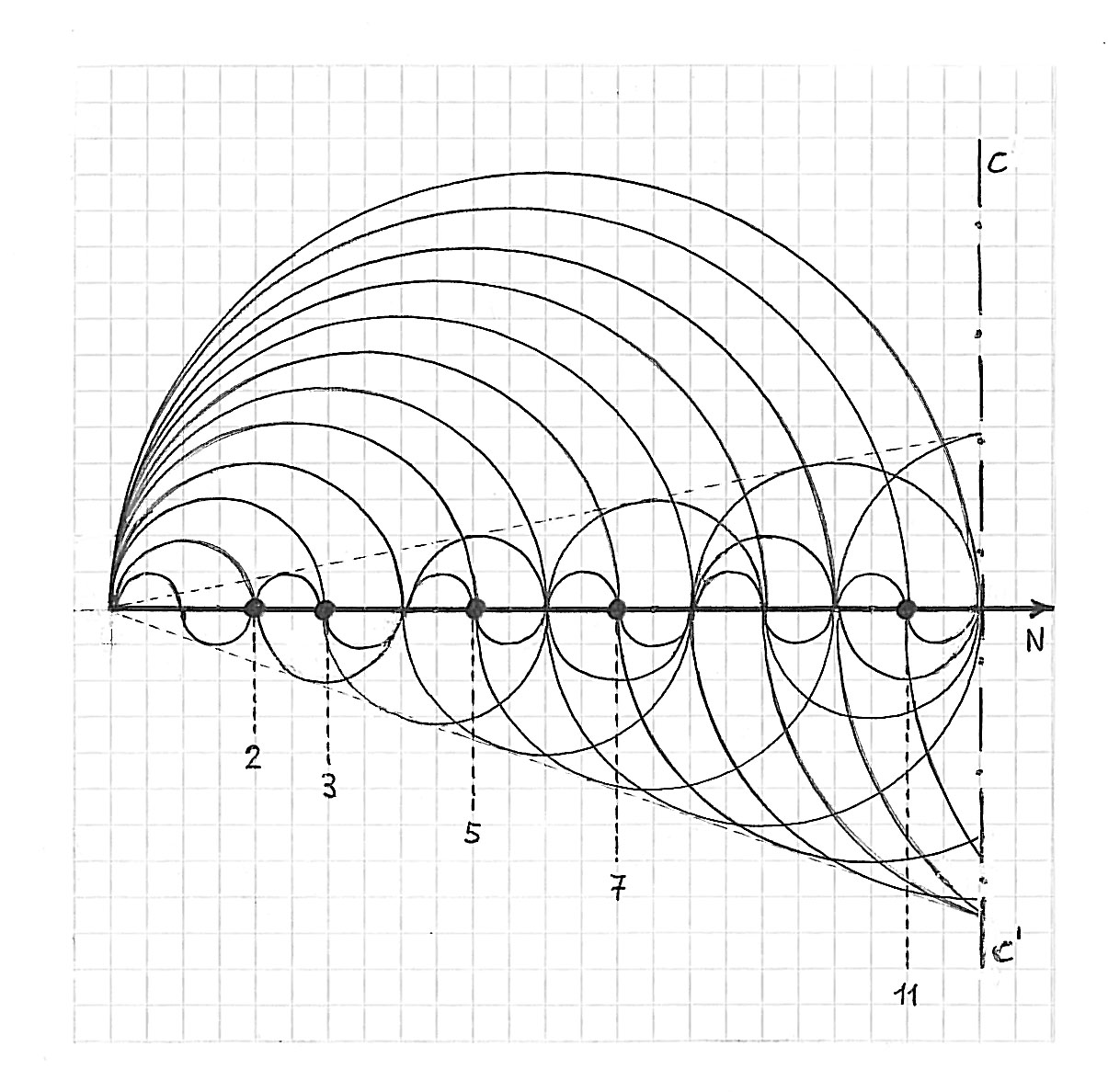
- Omar E. Pol, Illustration of initial terms
- Omar E. Pol, Sobre el patrón de los números primos, and from Jason Davies, An interactive companion (for primes 2..997)
- Popular Computing (Calabasas, CA), Sieves: Problem 43, Vol. 2 (No. 13, Apr 1974), pp. 6-7. [Annotated and scanned copy]
- Primefan, The First 500 Prime Numbers and Script to Calculate Prime Numbers.
- Project Gutenberg Etext, First 100,000 Prime Numbers
- C. D. Pruitt, Formulae for Generating All Prime Numbers
- R. Ramachandran, Frontline 19 (17) 08-2000, A Prime Solution
- W. S. Renwick, EDSAC log.
- F. Richman, Generating primes by the sieve of Eratosthenes
- Barkley Rosser, Explicit Bounds for Some Functions of Prime Numbers, American Journal of Mathematics 63 (1941) 211-232.
- J. Barkley Rosser and Lowell Schoenfeld, Approximate formulas for some functions of prime numbers, Illinois J. Math. Volume 6, Issue 1 (1962), 64-94.
- S. M. Ruiz and J. Sondow, Formulas for pi(n) and the n-th prime, arXiv:math/0210312 [math.NT], 2002-2014.
- S. O. S. Math, First 1000 Prime Numbers
- A. Schulman, Prime Number Calculator
- N. J. A. Sloane, "A Handbook of Integer Sequences" Fifty Years Later, arXiv:2301.03149 [math.NT], 2023, p. 5.
- M. Slone, PlanetMath.Org, First thousand positive prime numbers.
- A. Stiglic, The PRIMES is in P little FAQ
- Zhi-Wei Sun, On functions taking only prime values, J. Number Theory, 133 (2013), no. 8, 2794-2812.
- Zhi-Wei Sun, A conjecture on unit fractions involving primes, Preprint 2015.
- J. Teitelbaum, Review of "Prime numbers:A computational perspective" by R. Crandall & C. Pomerance
- J. Thonnard, Les nombres premiers(Primality check; Closest next prime; Factorizer)
- J. Tramu, Movie of primes scrolling
- A. Turpel, Aesthetics of the Prime Sequence [broken link ?]
- S. Wagon, Prime Time: Review of "Prime Numbers:A Computational Perspective" by R. Crandall & C. Pomerance
- M. R. Watkins, unusual and physical methods for finding prime numbers
- S. Wedeniwski, Primality Tests on Commutator Curves
- E. Wegrzynowski, Les formules simples qui donnent des nombres premiers en grande quantité (in French).
- Eric Weisstein's World of Mathematics, Almost Prime.
- Eric Weisstein's World of Mathematics, Prime Number Theorem.
- Eric Weisstein's World of Mathematics, Prime Power.
- Eric Weisstein's World of Mathematics, Prime Zeta Function.
- Eric Weisstein's World of Mathematics, Prime-Generating Polynomial, Prime Number, and Prime Spiral.
- Wikipedia, Prime number and Prime number theorem.
- C. P. Willans, On formulae for the nth prime, Math. Gazette 48 (1964), 413-415; doi:10.2307/3611701 available on JSTOR.
- G. Xiao, Primes server, Sequential Batches Primes Listing (up to orders not exceeding 10^308)
- G. Xiao, Numerical Calculator. To display p(n) for n up to 41561, operate on "prime(n)".
- Additional (less important) items -- comments, formulas, references, links, programs, etc. -- related to the prime numbers, [A000040](A000040). [HTML version] - [Plain text (TXT) version].
- Index entries for "core" sequences
- Index entries for sequences related to Benford's law
CROSSREFERENCES
- For is_prime and next_prime, see A010051 and A151800.
- Cf. A000720 ("pi"), A001223 (differences between primes), A002476, A002808, A003627, A006879, A006880, A008578, A080339, A233588.
- Cf. primes in lexicographic order: A210757, A210758, A210759, A210760, A210761.
- Cf. A003558, A179480 (relating to the Quasi-order theorem of Hilton and Pedersen).
- Boustrophedon transforms: A000747, A000732, A230953.
- a(2n) = A104272(n) - A233739(n).
- Related sequences:
- Primes (p) and composites (c): A002808, A000720, A065855.
- Primes between p(n) and 2p(n): A063124, A070046; between c(n) and 2c(n): A376761; between n and 2*n: A035250, A060715, A077463, A108954.
- Composites between p(n) and 2p(n): A246514; between c(n) and 2c(n): A376760; between n and 2*n: A075084, A307912, A307989, A376759.
- See also the official entry at https://oeis.org/A000040
METADATA
- OFFSET :
1,1 - KEYWORDS :
core,nonn,nice,easy,changed - AUTHOR : N. J. A. Sloane
- IDENTIFICATION :
M0652 N0241 #1432 Oct 25 2026 08:20:53 - CURRENT IMPLEMENTER : @goulu